by
by The following is an excerpt from Amy Kenny’s forthcoming book, My Disability is Divine.
Everywhere I turn, I marvel at nature displaying radiant disability. Crooked bushes— real name— are hunched, sprawling their limbs outward in every which direction. Their branches are like my “crooked” body, bent and beautiful in our distinctiveness.
The hues of crimson and carrot that sweep across the autumn trees are due to cold temperatures, shorter days, and less chlorophyll. The vibrant color change we witness signals the lack of productivity of these trees. We might say that the trees are following their access needs, resting instead of producing. This sounds a lot like spoonie and disability wisdom to me.
We can’t always produce— we don’t always have the energy to hustle— and just like the trees, we are vibrant and worthy of care. People mock us for knowing our limits, but we know the disability wisdom of following the rhythms of rest.
Deep beneath the ocean’s surface, an octopus has arms growing out of its head and can camouflage to hide from predators. These masters of disguise change their tint and texture to replicate nearby rocks and coral. Their physiological changes are much like the fluidity of dynamic disability, which describes the experience of access needs fluctuating from day to day. Some days I need help getting dressed and some days I don’t, but all days I can knock your socks off. And on all days, I am worthy of belonging and care.
No one claims kangaroos are feeble because they cannot walk backward. No one mocks sharks for communicating without speaking. The sound effect we associate with “shark!” is courtesy of Jaws, not nature. The ostrich is not weaker than the oriole because it cannot fly. We do not dismiss armadillos because they are hard of hearing, or elephants because they are born blind. No one claims lions have chronic fatigue syndrome because they languish almost all hours of the day. They are fast and fierce! They just act more like us spoonies than workaholics.
It turns out that the community of creation is disabled. The jaggedly majestic branches of the Japanese maple, the blind star-nosed mole, the flightless penguin. Nature is delightfully disabled. And so am I.
Throughout creation, we value the biodiversity that disability brings. Yet we’ve often failed to apply this value to humans.
What if we tried? What if we reconsidered the way we understand disability, so that disabled people are not just tolerated but celebrated? What if we recognized that we are better together? What if we understood my wheels as I do— an empowering throne that generates access and agency?
It was the community of creation that proclaimed my own radiance to me. I started to realize that if I could marvel at the vibrance of disability in creation, then why couldn’t I believe it about myself?
I started to allow myself to wonder, What if I, too, am divine? If I could consider the lilies of the field and the birds of the air as radiant, how come I hadn’t thought that about myself when confronted with a mirror, mirror, on the wall?
What if we fostered a community of care not based on everything that we are against but out of affirming the dignity and divinity of each one of us, just as we are? What if we recognized that disability is divine?
Perhaps if we expanded our imaginations to understand the vibrancy and vitality of disability, we could experience the divine presence in our disabled neighbors.
And then I started to realize that throughout Scripture, we encounter disabled people at the forefront of the relationships that Creator cultivates with humanity. Isaac becomes blind. Jacob walks with a limp and uses a cane in the cloud of witnesses. Moses has a speech disability. Elijah tells us about his depression. Timothy is chronically ill. Zacchaeus is a little person. Many of our autistic siblings read Noah as neurodivergent. And who can forget about Paul’s thorn in the flesh? Or that the Great Banquet is accessible?
Too often, we erase these disabilities when we talk about Scripture because they make nondisabled people uncomfortable. But make no mistake, disabled folks are part of our Scriptures and spiritual traditions. We are a vibrant, whole, radiant part of the beloved community, and we are divine.
We are not God, nor do we need to be. We are humans, and by virtue of being human, we emanate the image of God and partake in the divine nature (2 Pet. 1:4). There is no asterisk or caveat excluding disabled people from these divine dealings. Nor do we await an afterlife to be able to partake. We reflect the divine presence to an unsuspecting world, just as we are.
Adapted from My Disability is Divine by Amy Kenny. ©2026 by Amy Kenny. Used by permission of Brazos Press. bakerpublishinggroup.com.
About the Author
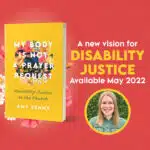
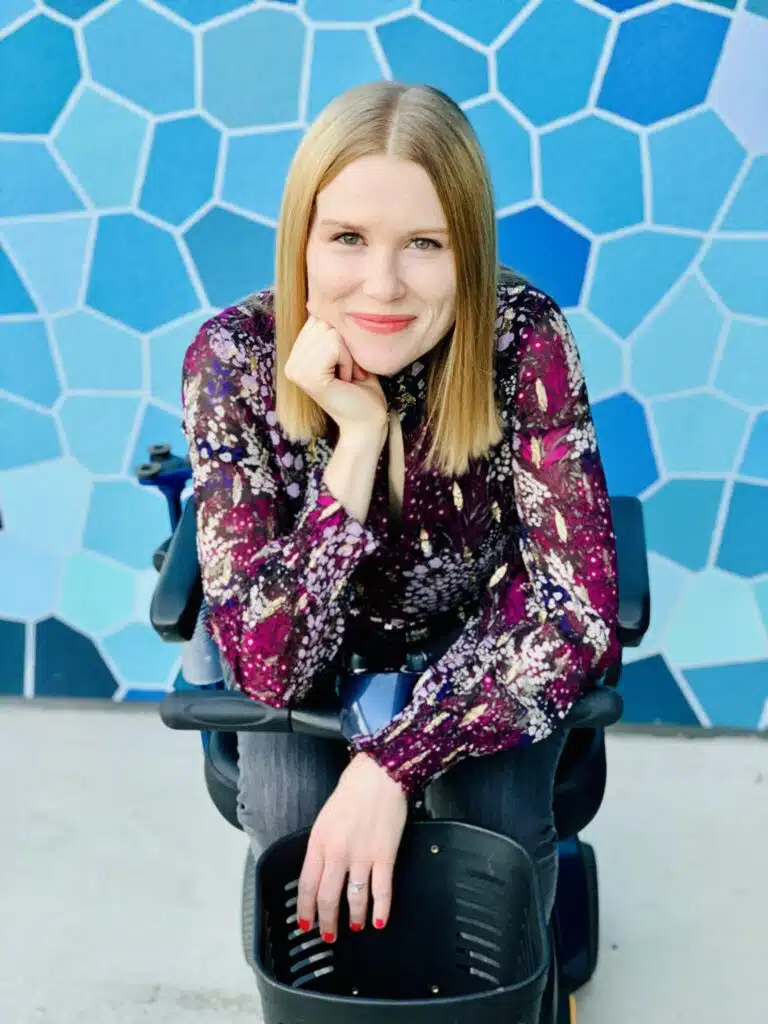
Amy Kenny, PhD, is a disabled scholar-practitioner and the founding director of the Disability Cultural Center at Georgetown University in Washington, D.C., one of only a handful of such centers in the country. She is the award-winning author of My Body Is Not a Prayer Request, and her work on disability has appeared in Teen Vogue, Sojourners, HuffPost, Reader’s Digest, and Shondaland. She also cofounded Jubilee Homes, a housing initiative for people experiencing homelessness.