by
by CCDA co-founder John Perkins and philanthropist Howard Ahmanson have known each other for over forty years. In this post, they reflect on their story and some takeaways to pass on to you. To learn more about their friendship, enjoy the book Called to Be Friends, Called to Serve (Cascade Books, 2025). The publisher is offering a 50% discount by ordering here when using the code FRIENDS50 at check-out (expires January 31, 2026).
Takeaway #1: Deep Friendships are Crucial to Human Flourishing
Two are better than one, because they have a good return for their labor. If either of them falls down, one can help the other up. But pity anyone who falls and has no one to help them up.
—Ecclesiastes 4:9–12
John: Those words spoken by Solomon kind of point to friendship as a crucial need for every human being. I’ve always said that I grew up with a big gaping hole in my heart because my mother died when I was a baby, my father walked away, my brother and one of my sisters were murdered. I was desperately in need of love, and I needed a friend.
Howard: I am proud to be a friend of John Perkins (affectionately known as Dr. John). He is an exemplary leader, consistently seeking to create a path toward helping the poor that is consistent with classical Christianity. For a number of reasons, a person in my financial position (as an inheritor of wealth) has to be on his guard. But John’s friendship with me has never been based on my financial status. Somehow, we have always deeply understood one another. In fact, because Dr. John is somewhat older, in a way I have seen him as a father figure. His sincerity and openness, and his ability to admit to his own prejudices and mistakes, have deeply impressed me.
Takeaway #2: Long-term Friendships Can Be a Hospitable Home for Working Out Individual Differentiation and Relational Differences
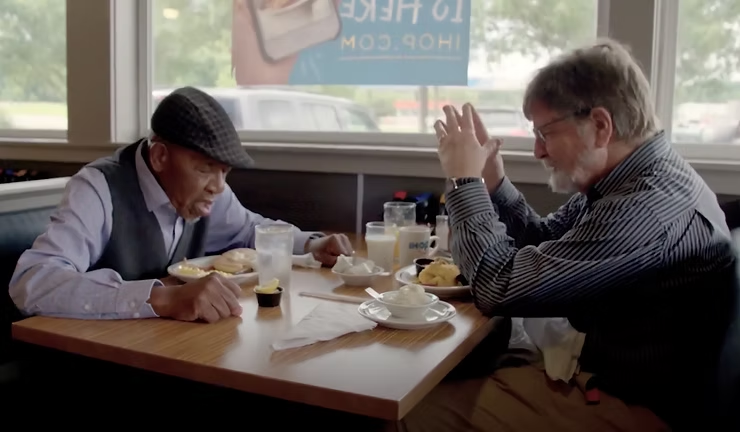
John: When Howard and I met, I had no idea that we would become friends. He was a generous contributor to our work and ministry and both of us were striving to develop a philosophy about how to help poor folks without patronizing them or doing damage to their dignity. And we didn’t know it at the time, but we were both longing for a friend. To say that we came from different sides of the tracks would not say enough about how different we were. He was educated; I finished enough schooling for the fifth grade. He was wealthy; I came from a bootlegging family in Mississippi that ran afoul of the law most of the time. He grew up in Southern California; I grew up in the Jim Crow South. He was younger; I was older. He is white; I am black.
Howard: I first met John at a salon for social action in 1982. I liked him immediately. He was clearly highly intelligent and had surrounded himself with good people—many of whom were very different from him. And that never seemed to trouble him at all. In his early years, Dr. John experienced intense and incomparable suffering, not only because he was black, or poor, but because he had taken a stand for equal rights for African Americans. As for me, I enjoy a lot of privileges besides just that “white” one. I grew up with great wealth as a “trust fund baby”—a category of people not particularly admired in American culture. But Dr. John and I have gotten to know one another as individuals, and that has always come first in our unlikely friendship. I would hardly compare the “hardship” of my background to what John Perkins experienced in his early years—tragic and brutally violent events you’ll read about in Called to Be Friends, Called to Serve. But one thing we have in common is a past marked by suffering, which I think plays a significant part in the common ground we continue to share. I have both Asperger’s and Tourette’s syndromes; neither of them was properly diagnosed until I was forty-six years old. And at age eighteen I was misdiagnosed with schizophrenia and spent a year and a half in an institution.
Takeaway #3: Differences Are Not the Only or even “Final” Story When Friendship is Rooted in Jesus through the Holy Spirit
John: Any one of those differences in our backgrounds could have kept us from ever becoming friends. Differences can either attract us to others or they can push us away. It’s easy to be drawn only to people who look like us and act like us. The hard thing is to see someone who is so unlike you, but to find a way to cross over the differences and risk being hurt or rejected. For rich people, I think the struggle is to not see the poor as objects and to feel superior to them. And for poor folks, it’s the same struggle to not see the rich as objects, but also to not feel inferior to them. That’s been a hard thing to deal with in our friendship. And you’ll read about some of that in Called to Be Friends, Called to Serve.
Life is full of problems. But friends find a way to keep the relationship bigger than the problem. That’s what Howard and I have done. We have been able to weather some big storms and find our way through them together. Some of those storms helped to deepen our friendship. You don’t really know if a person is a true friend until you come to a point of conflict. And conflict is bound to happen because we’re all plagued with that Adam brokenness. We all sin. And the only way to deal with sin is with forgiveness. And that’s what Howard and I have given each other.
Howard: Neither John nor I are what could be called “middle class,” although for opposite reasons. Yet we have traveled the world together and have viewed scenes of poverty like nothing either of us had ever witnessed before. Once in Australia, I was moved by John’s message to marginalized Aboriginal tribes on a remote island, where he offered them a message of hope and the challenge to help themselves, with God’s grace, not to become dependent on others. It may well have been the first time a black American pastor had ever spoken to them.
Some years later, we hosted the Perkins family in our California guest house. Late at night, one of their children accidentally pressed a button that triggered an alarm, and the police almost immediately surged into the neighborhood and stood at the door. After having endured brutal abuse at the hands of white policemen in his highly segregated southern hometown, Dr. John was suddenly confronted with a team of well-armed Newport Beach cops. Thankfully the good doctor’s sense of humor prevailed. He thought it was hilarious that the Newport Beach police had unexpectedly encountered an entire houseful of black people—in the heart of a very white California beach community. The next day we all laughed together. I was amazed that someone who had been beaten to within an inch of his life by police thirty-five years before could now find all this humorous!
John: A true friend will stick it out and work through it. And it’s that working-through that draws the two into a closer and stronger relationship. When I think back over the years, I realize that Howard was discipling me as I discipled him. Discipleship and friendship are one and the same. We mutually loved each other, we respected each other, and we were looking at the world together and trying our best to make things better.
And there has been an even greater force at work to cement our friendship. In truth, the glue that has held Howard and me together as friends for these many years is the Spirit of God. When He lives in your heart and controls you, amazing things can happen. He has knit our hearts together and shown us how to appreciate one another’s differences, how to overlook things that don’t really matter, and how to love with the love of Jesus. And that love has overflowed to my wife, Vera Mae, and his wife, Roberta. In many ways we have become like an extended family—plagued by all the issues that trouble many families—and blessed by all that is good and worthy in families. I’m grateful for that—so very grateful.
Howard: Indeed, another thing Dr. John and I have in common is that we are blessed with fine wives who have backed us up in our many efforts, together and apart. I have one child, while John and Vera Mae have eight. These are wonderful blessings we both celebrate. I can’t imagine where either of us would be without our families, and without the friendship we all have shared for so many years.
The text of this post was adapted from John and Howard’s Prefaces in the book Called to Be Friends, Called to Serve (Cascade Books, 2025). Used by permission of Wipf and Stock Publishers.