by
by What if we have been looking at most of our formation upside down? Most of the bell curves we use to describe the life cycle of an organization, church, non-profit, or business start with birth, move upward through growth and maturity, hit a peak in plateau or stability, and then begin to descend into decline, dropout, and eventually death. It feels unusual if an organization discovers a breakthrough despite its failures or inadequacies.
This is similar to our personal formation. We are born, grow, mature, peak, and then begin the slow descent into death. Against this backdrop of life and death, we are obsessed with our “best life now,” or the “best is yet to come,” and so many aspirational quotes and stories of breakthrough to temper the pain, suffering, and injustice that exist in our lives and communities.
The Lenten Call to Sacrifice
Lent is about the most anti-“the best is yet to come” season of the church year. It is unapologetically about learning to practice self-control and denial, and it asks us to embrace suffering. From dust you have come and to dust you will return.
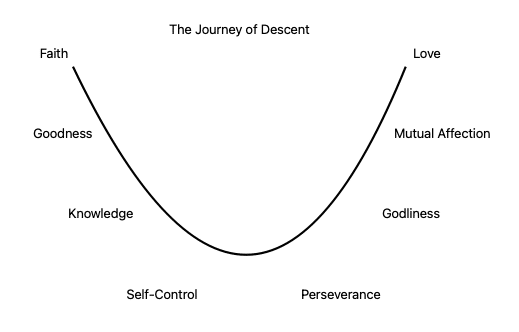
The season that leads up to Easter is a training ground for learning to walk the path of descent. It invites us and challenges us to walk the u-curve as a primary pathway to love. 2 Peter 1:2-9 (NIV) says:
For this very reason, make every effort to add to your faith goodness; and to goodness, knowledge; and to knowledge, self-control; and to self-control, perseverance; and to perseverance, godliness; and to godliness, mutual affection; and to mutual affection, love. For if you possess these qualities in increasing measure, they will keep you from being ineffective and unproductive in your knowledge of our Lord Jesus Christ. But whoever does not have them is nearsighted and blind, forgetting that they have been cleansed from their past sins.
The path from faith is a move into goodness, then knowledge, which leads to self-control and perseverance. Goodness and knowledge don’t lead to a mountain top but rather a valley of intentional sacrifice and prolonged struggle. Self-denial and endured suffering help us to grow in the likeness of God, which helps us to practice mutual affection and love. This is not a story of adding one good thing to another and then resurrection. This is a description of godliness that is shaped by sacrifice.
The Right Path ≠ The Easy Path
What if Lent is a necessary reorientation for how we become mature imitators of Jesus? Could Lent be the most helpful season of the church year to challenge our regular sensibilities that the aim of our spiritual life is to remain on the life side of any life cycle? Is it possible for groups of people to actually embrace the cross as a pathway to new life in our community with our community?
Could Lent be the fertile training ground to disciple our way into the ability to embrace conflict, see one another, grow in presence and proximity, and live sacrificially in an era of self-promotion and influencers? Could this intentional season of denial, sacrifice, and perseverance actually help us to regulate our emotions and relate to the Jesus who isn’t just God with us but is also the God who suffers with us?
Difficult circumstances in life don’t necessarily mean that you are out of step with God. And being comfortable in life doesn’t mean that you are right in the center of God’s hopes for your life, either. But in a country that is often obsessed with self-expression and naming our truth we often overlook the incredible sacrifices that were made by civil rights leaders, immigrant neighbors who left home to make another home, everyday non-profit leaders who show up with kids when no one else shows up, and BIPOC leaders who have stayed at the table only to watch white leaders leave when things were inconvenient.
Long-term perseverance leads to godliness, and yet we often want to avoid suffering as a pathway to love.
Safety Before Progress
When we find ourselves in situations of life where things are scary, complicated, and don’t make sense, sometimes we have to find safety and refuge before we can make progress. This means that being prophetic while having thorough relationships with our immigrant neighbors might mean knowing when to let other parts of the body of Christ be the mouth while you tend carefully and wisely with hands and arms.
There is a novel by Anthony Doerr that was recently made into a series on Netflix called All the Light We Cannot See, and the novel is set in World War II. Marie-Laure, a blind French girl, and her father face challenges when Paris is invaded by Nazi from Germany, and they are forced to flee.
A beautiful part of this story is how this father makes scale models of the city of Paris, so that as his blind daughter, Marie-Laure, grows up she can learn the city, count her steps, and get a sense of the buildings, roads, and important landmarks so that she can get around the city even when her father isn’t with her. This father knew that by moving Marie-Laure out of Paris, everything that was familiar—the buildings, the sounds, the smells, everything that she knew would be gone. She would lose the very anchors that helped her to be independent and free.
This transition to a new city was costly and complicated for Marie-Laure. But the father knew that he had to find safety before progress. Both in the story and in our lives, self-control leads to perseverance. This season of the church depends on us learning how to make meaningful sacrifices on behalf of one another so that we might discover the cross-shaped resurrection together.
About Josh Hayden
Rev. Dr. Josh Hayden is the Senior Pastor at First Baptist Church in Ashland, VA. Josh studied leadership and organizational change while writing Creative Destruction: Towards a Theology of Institutions to receive his Doctor of Ministry at Duke Divinity School. He is the author of Remissioning Church: A Field Guide for Bringing a Church Back to Life. Josh works with churches, networks, denominations, and various organizations to see the big picture, lead on the ground, and make disciples from the inside out. He is married to Shey, and they have two sons, Rowan and Eli.